Facebook Applications crash on Google Chrome. Is this just a Google Chrome Beta nuance or a dirty tactic of google? Well many Facebook applications are apparently not working on Google chrome and facebook users who would wish to try and use chorome are getting annoyed.
This has left me wondering if Google Chrome left these issues unhandled in the BETA launch deliberately? Some time back Facebook with it's popularity and a strong product as well as a high performing team attracted many people from Google. Even though no one could do anything about it but does that mean google played dirty this time?
After the BETA launch yesterday over 100,000 users have downloaded the Google chrome and people have started testing various website compatibilty on Google Chrome. However, many websites are facing issues with Applet loading, pages being skewed, security settings not customizable etc.
Well few simple examples:
Auto cleanup of the browsing data feature when the window is closed is not there.
Popup enable feature is not there.
Favourtites folder is not there.
Yes may be Dynamic Bookmarks is the next level of browsing but can we customize our browser or do we have to go by Google's Verdict?
Well, Google Chrome is here to WOW the users and I am sure they are listening....
When Google gets down to making Internet Experience better there is nothing which compares to their expertise in making MOST user friendly applications. One of the biggest steps after capturing the majority search engine space, yesterday Google launched it's WOW browser - Google Chrome. The way their marketing team built an entire Google Chrome storybook of How the entire Google Chrome browser came into existence is Ossum. The FRESH Technological approach adopted in Google Chrome has brought out some Wonderful features.
Right now in it's BETA stage, tweaking features is mostly restricted. Very few tweaks are available to users till now. Also, auto clear-up of private data once you exit from browser is not available. There is an interesting feature of Incognito Browsing which ensures that webpages that you open and files you downloaded won't be logged in your browsing and download histories; all new cookies are deleted after you close the incognito window.
Search while you type URLs - Google brought it's search prowess to google chrome by providing you the feature of showing popular site results and other historical data from your search tracks while you type a url.
Application Shortcuts, Dynamic Tabs, Favourite web pages in quick launch, Crash Control and Safe Browsing are some additional features added and surely they will WOO the new and existing users of Microsoft Internet Explorer, Mozilla Firefox and Safari.
Technically one of the biggest advancements is Handling each Tab as an individual process/thread which helps you in case one of the process is non responsive. Sandboxing and Crash control really ensures smooth working of the browser application.
One thing which I monitored was that the CPU usage and Physical memory usage was a little higher than firefox / IE while running multiple tabs in Chorme as the number of Application is ONE but the number of processes were equal to the number of tabs so more load on the processor and memory.
Let's see if the full version of Google Chrome really WOWs the audience or not....And well this also makes me Wondering, WHY Don't GOOGLE make an Operating System?
After Scour.com with Social search now there is CUIL.com a completely new search engine. A former Google employee and her husband launched a new search engine this Monday called Cuil (pronounced as "cool"), aiming to topple Google by indexing more Web pages than the search giant.
After the Web 2.0 buzz across the globe, it looks like it's the time for Search Engines...with news about search engines every day, I feel like I am bathing in a Search Engine rain.
Cuil, situated in Menlo Park, California, is led by Anna Patterson, a former leader of Google's search index and her husband, Tom Costello, who researched and developed search engines at Stanford University and IBM. The two, president and CEO, respectively, met at Stanford.
Russell Power, the third cofounder of the group, also worked at Google on search indexing, Web rankings and spam detection. He works as vice president of engineering at Cuil.
Cuil, claims it has indexed 120 billion Web pages and can provide results organized by ideas with complete privacy for users. While on the other hand, Google, on Friday claimed it had discovered 1 trillion unique Web pages on the Internet.
Cuil said its search engine goes beyond traditional approaches by analyzing the context of each page and the concepts behind each query so it can provide better rankings by content rather than popularity. Cuil then organizes similar results into groups and sorts them by category. It also offers tabs to clarify subjects, as well as suggestions on how to refine searches.
Cuil and Scour aren't the first Google rival to launch this year. Wikia Search, a highly anticipated search engine from Wikipedia founder Jimmy Wales, made its official debut in January. Wikia Search hopes to provide better search results by allowing a community of users to index pages by using their Web page rankings and other suggestions, as well as its own indexing of the Web.
Though, seems like the servers of Cuil are already getting heated up (image below), which is good in a way, as they would have wanted a huge traffic to come to them.
A long awaited but a welcome step from Google when it added the search volume data for keywords and Ad placement flexibility to the Adwords platform.
Some time back I wrote about Google's Hogwash on how auctions set prices, and my key argument was that there was no campaign data available. However, with the below mentioned new tools and features added by Google, it proved again that they are the Best and the most pioneering and innovative Search company who really listens to customer's demands and deliver on the same. Hats off to you guys!
Now, both keywords and placements can be targeted in all AdWords campaigns. We can now use both to get better control and pricing power on the content network. (this was a big disadvantage earlier)
What can you do with keywords plus placements?
Bid more or less for specific placements. Let contextual targeting with keywords place your ads across the content network, while you set placement bids for sites that have a special value for you.
Selling soccer shoes? You might bid $1.00 for clicks from any content network pages that match your keywords, but $2.00 when those clicks come from a soccer fan site that's converted well for you in the past.
Show your ad only when both keywords and placements match. You'll get the benefits of keyword targeting while also limiting the places where your ad can appear.
For instance, set your campaign to appear only on your favorite soccer fan site, and only when the site content matches the keyword soccer shoes. You may see less traffic, but AdWords contextual matching will help make sure your placement pages are highly targeted.
Instead of creating separate campaigns for keywords and placements, you can now include both in any campaign. All ad groups now have tabs for both keywords and placements, and the two can work together to target your ads on the content network.
Keyword-Targeted
Placement-Targeted Online
Here's an example: You might target the keyword roses and the placement *www.example.com*. You can let the keyword roses display your ad across the content network, and use placements to raise your bid whenever roses triggers your ad on www.example.com. Or you can choose to have your ad appear only on www.example.com, and only when its content is a match for roses.
Pick Keywords
Pick Placements Google finds pages that meet both criteria
Well, what pleases me most is the way Technology and Marketing have got married these days. It's the nupital knot which any Techno-Marketing professional would want to get into. And additionally what makes me feel elated is the way companies are learning from there customers and prospects through social media and using that feedback to come up with better product features and solutions for the customers.
www.Scour.com - World's own Web 2.0 Social Search Engine How is scour different from anything else? What is a social search engine anyways? Can Scour - Social Search Engine gives Google, Yahoo, Microsoft a run for their money? How is Scour different from the rest?
Scour - the social search engine, is a reward based search engine which brings in the search results from Google, Yahoo! and MSN, all together with their rankings. You can comment and vote for the search results that you get and you don't have to switch to various search engines to get the best results which are most relevant for you.
The huge opportunity this social search engine brings is to involve the individual searching into the revenue sharing model. This incentivising technique attracts the individual to come back and search on scour and nothing else. Social search, I guess, was the only phenomenon left in the Web 2.0 space which was started by the social search engine AfterVote and is now known as Scour! Dan Yomtobian, CEO, Scour.com explains the concept behind Scour in the Video below:
Social search or a social search engine is a type of web search method that determines the relevance of search results by considering the interactions or contributions of users. When applied to web search this user-based approach to relevance is in contrast to establish algorithmic or machine-based approaches where relevance is determined by analyzing the text of each document or the link structure of the documents.
Social search takes many forms, ranging from simple shared bookmarks or tagging of content with descriptive labels to more sophisticated approaches that combine human intelligence with computer algorithms.
The Search experience revolves around the outcome of collaborative harvesting, collaborative directories, tag engines, social ranking, commenting on bookmarks, news, images, videos, podcasts and other web pages. Examples of user input include social bookmarking or direct interaction with the search results such as promoting or demoting results the users feel are more or less relevant to their query.
Some time ago AfterVote was acquired by ABCSearch, one of the largest pay-per-click search companies in the world. As a result of this acquisition, the product has a much better backing for growth and quality and its offerings are now bigger and better with this move. The original core development team from Thinking Big is still deeply involved in Scour, but it has more resources, better servers and a richer brain trust to improve the quality and accuracy of daily information search needs.
So what would be the next step? Will Google, Yahoo and Microsoft acquire stake in this company? I guess considering MS couldn't lay its hands on Yahoo!, Scour's popularity might attract MS to consider a stake.
Also, interestingly the commenting and voting attracts the individuals to look around which can also mean that click/ad revenue Scour search engine might be better. This clearly means that advertising dollars would start flowing in for Scour.
However, monetizing commenting is not that great an idea as it would lead to spam comments and would eventually be of no use to anyone. If there is no moderation / trusted member validating comments, it would lead to disruption of search results which will go against the pure reason of existence of Scour - ie Search.
As of now I am starting Scouring but the real fate of Scour needs to be determined in the coming years!
Google's recent blog entry on how Google sets the ad prices for their Ad-words program is a sheer hogwash.
Hal Varian, their chief economist, explains the entire bidding process and how the highest bid price and quality score determines the final prices of the bids that the advertisers have to pay.
I respect google's ad-words program creator and conceptualizer for bringing the Online Ads to reality and making it a Star performer for Google with over a Billion dollar in revenue. However, now it's just become a clear machine for google to hogwash advertisers by their complex statistical algorithms gimmick.
For Eg: If I have set-up a budget for lets say $10/day the cost of the adwords is low. However, if I increase my daily budget to $100 the cost of the same keyword will go high even when there is no other bidder for the same keyword. I have tested this multiple times.
Also, lets say the quality score determined by google is low. However, I might have a strategic benefit behind choosing a certain keyword for a limited time period. The automated process can not identify that and Google changes the cost of the keyword exorbitantly just as a "curbing tactic".
Also interestingly google's content network gets a very high clickthru rate than the search network. So, isin't it obvious that Google should somehow provide that information on the campaign report that who are the people clicking in the content network.
When google complains about click frauds...it makes me wonder...what if its a 2 way fraud? Why does google has to increase the bid price even when no one else is bidding?
Also, I am just wondering why the people who were chief architects and key contributors in a lot of google's products have left google ? Here are they now and how facebook is stealing people from google.
My online media evangelism is making me more generous towards the traditional media marketers or you can call it’s a sympathy gesture to myself (for the time I spent in traditional media). Here is a piece of advice for the traditional media marketers to track the ROIs from the offline media campaigns (which is a hard nut to crack otherwise).
Let’s say you are running TV, Radio, Print ads for certain campaign and you wish to track your ROI. Neither this is a fool proof method nor will it give you an accurate tracking, however, it can act as an add-on to your regular media tracking tricks. Assumption made here is that you would be using some call to action in your campaign and tracking it back to your results.
Try to use a “keyword” or a “buzzword” in your campaign as a call to action. Now, much before launching your offline campaign, you can look at the search engine volumes for the specific keyword which you are going to use in your offline campaign.
Identify some popular search engines in your region and start running a fixed time SEM campaign. Buy out certain keywords that you are going to use in your offline campaign and you expect that those keywords will be searched by people in search engines.
Now bid for those keywords and keep a close track on the search engine traffic coming to your website through those keywords before launching the offline campaign. This is the base setup which will work as the platform for you.
Once you start your offline campaign monitor the post campaign increase in search volumes of your keywords and the increased traffic to your website. Determine whether your offline media has a positive ROI impact by evaluating whether this incremental search traffic got you additional searches, enquiries, sales, etc.
Was it worth investment on your offline media initiatives? In case your business is not at all online, and you know, for example, that majority of your business is done by phone or in stores; you could look at increased search volumes when calculating ROI.
This is how Online Media and search engines can help you measure your ROI and track the results a little better than what you might be doing now!
On 4th March 2008, Hal Varian, Chief Economist at Googleblogged about the privacy and how search is being improved day-by-day at Google by "learning from crowds" by analysing billions of search logs and experimenting with people's data and delivering better results. I thought, as a marketer I should learn something from it, you never know I might need to profess something similar in my job, sometime in future!
When you read his blog entry, initially, the history of search is given, to divert attention from the topic and build a story around it and sweep away the readers mind with emotional touch by talking about “how two poor chaps doing research” started this company, as other search companies didn't buy their algorithm...Alas, they must be cursing themselves now...
Then the actual pitch comes, talking about how user information is “protected” and “leveraged” only for user experience improvement purposes!
Hal says: “We're constantly experimenting with our algorithm, tuning and tweaking on a weekly basis to come up with more relevant and useful results for our users.” Very interesting unsolicited experiments which are not explicitly explained and subjected to you and only after some time when you realize the ads are getting more and more personalized is when you realize that you are part of the experiment!
After watching the cool Support Engineer chick presenting the videos on privacy at Google by explaining how Cookies work and how Web History works it’s really interesting to analyze how Google professes its neutrality and customer oriented approach. (I love you guys from a marketing perspective, everyday I learn new words and sentences in English language and how to use them in a politically correct manner whenever it’s needed, Thanks again!)
The website on which these videos are posted is owned by Google along with the ability to post comments (obviously it’s moderated). The web history is "definitely helpful" (pun intended) to give more relevant search results as well as more relevant ADS. How does Google earn revenue? Ads, I guess! (why can't you admit it?)
If you want to learn and better the user experience, ask the people to voluntarily participate in your search experiments instead of the way you do it by choosing on your own!
Maile Ohye, support engineer at google says an IP address doesn’t say who you are or exactly where you are…Are you sure? Did we hear Webtrends and Visual Sciences or even better Google Analytics along with email marketing solutions with web tracking saying we provide tracking of visitors on your website and did we hear Akamai saying we provide directory of companies hosted on each IP so that you can track who visited your website?
Though I like the innocent face of the support engineer and the simplicity with which she mops up things! Great job keep it up! BTW: stop giving Cars, Carss, Bass examples. What about examples like my buying behaviour or my healthcare searches?
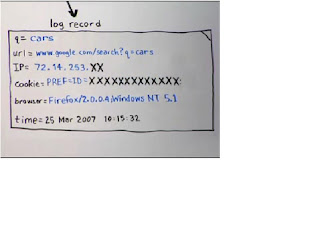
Though the interesting thing to notice is that in coming 18 months, google is going to cut out the last 3 digits from the IP log display. As well as the preference ID from the cookie like below:
This would be an interesting move to watch, this hasn’t been attempted by any search engine till now. This step on one side might annoy Web tracking companies a bit, on the other side would be a consolation for common man.
Having said all this, my simple questions to Google are:
“Did the users ask you to provide more relevant search by picking their information?”
“Did users say that I am not getting relevant search results and now I am moving to a new search engine?”