Showing posts with label Behavioral Marketing. Show all posts

Friday, July 18, 2008

www.Scour.com - World's own Web 2.0 Social Search Engine

www.Scour.com - World's own Web 2.0 Social Search Engine

How is scour different from anything else? What is a social search engine anyways? Can Scour - Social Search Engine gives Google, Yahoo, Microsoft a run for their money?

How is Scour different from the rest?

Scour - the social search engine, is a reward based search engine which brings in the search results from Google, Yahoo! and MSN, all together with their rankings. You can comment and vote for the search results that you get and you don't have to switch to various search engines to get the best results which are most relevant for you.

The huge opportunity this social search engine brings is to involve the individual searching into the revenue sharing model. This incentivising technique attracts the individual to come back and search on scour and nothing else.

Social search
, I guess, was the only phenomenon left in the Web 2.0 space which was started by the social search engine AfterVote and is now known as Scour! Dan Yomtobian, CEO, Scour.com explains the concept behind Scour in the Video below:


What is Social Search?

Social search or a social search engine is a type of web search method that determines the relevance of search results by considering the interactions or contributions of users. When applied to web search this user-based approach to relevance is in contrast to establish algorithmic or machine-based approaches where relevance is determined by analyzing the text of each document or the link structure of the documents.

Social search takes many forms, ranging from simple shared bookmarks or tagging of content with descriptive labels to more sophisticated approaches that combine human intelligence with computer algorithms.

The Search experience revolves around the outcome of collaborative harvesting, collaborative directories, tag engines, social ranking, commenting on bookmarks, news, images, videos, podcasts and other web pages. Examples of user input include social bookmarking or direct interaction with the search results such as promoting or demoting results the users feel are more or less relevant to their query.

Some time ago AfterVote was acquired by ABCSearch, one of the largest pay-per-click search companies in the world. As a result of this acquisition, the product has a much better backing for growth and quality and its offerings are now bigger and better with this move. The original core development team from Thinking Big is still deeply involved in Scour, but it has more resources, better servers and a richer brain trust to improve the quality and accuracy of daily information search needs.

So what would be the next step? Will Google, Yahoo and Microsoft acquire stake in this company? I guess considering MS couldn't lay its hands on Yahoo!, Scour's popularity might attract MS to consider a stake.

Also, interestingly the commenting and voting attracts the individuals to look around which can also mean that click/ad revenue Scour search engine might be better. This clearly means that advertising dollars would start flowing in for Scour.

However, monetizing commenting is not that great an idea as it would lead to spam comments and would eventually be of no use to anyone. If there is no moderation / trusted member validating comments, it would lead to disruption of search results which will go against the pure reason of existence of Scour - ie Search.

As of now I am starting Scouring but the real fate of Scour needs to be determined in the coming years!

Saturday, March 15, 2008

Google - “A Prediction Shop”?

Google is almost “Human”.

Internet psychologist Graham Jones in his post on his website on 13th March’08 says psychologists prove Google is almost “Human”. He supported his conclusion on the research done by researchers at University of California, Berkley.

An excerpt of the research report said:

“Human memory and Internet search engines face a shared computational problem, needing to retrieve stored pieces of information in response to a query. We explored whether they employ similar solutions, testing whether we could predict human performance on a fluency task using PageRank, a component of the Google search engine. In this task, people were shown a letter of the alphabet and asked to name the first word beginning with that letter that came to mind. We show that PageRank, computed on a semantic network constructed from word-association data, outperformed word frequency and the number of words for which a word is named as an associate as a predictor of the words that people produced in this task. We identify two simple process models that could support this apparent correspondence between human memory and Internet search, and relate our results to previous rational models of memory.”

So now my question is: Is this good or bad for me, as a search user?

Good Side: If I am thinking of some specific term in my mind and I google that term, in most probability google shows me the most relevant response. Wow it is good! Well it’s based on there algorithms, their experiments, their learning from data of masses and billions of queries and web history and many more reasons. So in a way I am happy that I got what I wanted. So google is not evil and truly giving me very precise search results.

Bad Side or Not? If google can give me the relevant search results of the stuff that I am searching for, does that also mean that they knew at one point of time in future I am going to search that? Something like a predictive search? And if yes, if they know what I am going to search for that means, they are going to serve me that even without me searching for it eg: If they know that I won a online marketing contest and previously I have been searching for a vacation in Thailand, so are they not going to serve me ads on Vacation Planning and special tours in Thailand?

Now this is debatable. Should I be happy about Google knowing that I am planning for a holiday in Thailand and they offering me relevant tour operators who can help me find a good package or should I be left alone to decide on my own through my research to find the best for me?

Last but not the least…So will a Machine algorithm take over Human Mind, and will google become a prediction shop?

Wednesday, March 12, 2008

4Rs of Email marketing – A Practioner’s Guide!

4Rs of Email marketing – A Practioner’s Guide!

An in-depth tutorial or a hand-book on email marketing or a practitioner’s guide to email marketing. I have covered various components of email marketing. I have tried to put together resources from various email marketing or lead automation solution providers in a single place.

3 years ago I got introduced to a simple yet effective concept of marketing, “Email Marketing” or “Inbox Marketing”. As simple as it sounds, it means sending an email to a prospective customer or an existing one, either to share some existing piece of information, or about informing or educating them on some new product or service that you can offer or may be just to say “Hi”.

Well Email marketing has been highly regarded for being able to get the highest returns on investments. It involves the least cost, requires the least set-up time, and you can see the responses very quickly. Though it might just sound like sending out an email, it’s not that simple!

In today’s time people can choose what they want to receive in their inbox. The good old ways of pushing the message in someone’s inbox is gone. Today’s it’s about the 4Rs of Email Marketing: - Relation, Request, Relevance and Returns/Revenue.

In simple words, today marketers need to strike up an engaging relation with prospects or customers during which the customers could request for some information and the content that you are offering should be relevant to the customers or prospects to get real returns on your investments (Revenue).

Components of Email Marketing

-Email Content
-Email Subject Lines
-Email Testing
-Email Design CTAs
-Email Opt-in Techniques
-Deliverability
-Key metrics – CTRs, Opens, Forwards

4 Rs in Action: - Relation building – Requesting Opt-in – providing Relevancy - ROI

Email Content – Keep the promise!

How do you build a relation with your friends? May be you get introduced by someone to a friend or may be you met someone somewhere (online in this case) or may be you just make a promise and live up to it and strengthen your relation with friends and over a period of time convert them to loyal friends.

It’s something similar in case of a customer relationship management through email marketing. Let’s say you were running an ad in a website or hired some space in a targeted newsletter and you were offering something useful for a prospective customer, you started generating traffic to your website through it and got people interested and started increasing your list size. Now, what is important is that you should remember to “keep the promise”, the promise that you made while gathering the information of the prospect. You made a promise to deliver a useful and relevant piece of information like a whitepaper, survey, research report etc. Obviously you should focus on your business, definitely, however, keep your promise by investing in the promise that you made continuously. Or else, you would be not more than anyone else in the same business. The only way you can differentiate is by keeping your promise to the customer during the time you acquired that customer’s relation.

As relevancy is taking the utmost importance in today’s time, it’s imperative to deliver highly relevant content. There are various ways to achieve this. You can manage your CRM system effectively and capture various details about your customers and prospects and leverage that date for delivering highly relevant content. This is no rocket science. It’s something which Google.com, Amazon.com, Yahoo.com and many other companies do, by learning about your preference and delivering what you need.

Additionally you can look at Omniture Segmentation Guide, Docmetrics - Document Optimization, Silverpops – Testing Methodology, Forrester’s Web Analytics report, Geographical optimization, Behavioral Triggering and Instance based triggering.

So let’s say while you are building your CRM database, keep a field open which says “Acquisition Source” which can be a pick list with values like: Banner Ads, Ad Words, Referral, Forward from a Friend etc. However, important thing to notice is to keep another field which says offer chosen like: Whitepaper, Survey, Research Report, Tech Paper, Event registration, Tips and tricks, Videos etc.

Just by doing this small activity you know later on what the interest type of the person was, so that the next time you wish to roll out some offer, you can just bundle it with another Whitepaper, Video, Survey etc and you were able to deliver on your promise while keeping your relation and relevancy.

Some important things to keep in mind are not to use potential SPAM words in the content or else your email deliverability will get hurt. Find the list of TOP 100 potential spam words here.

Email Design and Subject Lines
46% of Marketers take 15 secs to create email Subject Lines

One of the most important things in email marketing / website content development is the subject lines. Even though the above statistic is just an example to showcase that how a good subject line should be, simultaneously, it’s an indication that a lot of marketers do not spend enough time in creating subject lines.

I have created subject lines which have got me open rates as high as 40% and clickthru rates as high as 20% however, I have also created bad subject lines which yielded open rates as bad as 8% and clickthru rates of 0.7%.
It’s very evident from my experience that a good subject line can really decide the success and failure of a campaign. Just imagine you spent hours all together with teams in brainstorming and coming up with the right strategies and communication messages. But while executing you forgot to test the subject line and spent like 5 secs. in creating something that struck you at that moment and suddenly the entire campaign fell through as people didn’t open your emails at all.

Damn it’s annoying but true, that, something as simple as a subject line can kill the productivity of a brilliantly crafted message and designed campaign.

Some examples which work … mostly:
-Personalization
-Questions
-Emotive words
-Using statistics
-Using numbers
-Using company name
Put Whitepaper: , Survey: , Tech Report: , as the starting words.

Here are some examples:
-Hello {firstname}, are you among the TOP 100 {jobtitle}?
-Hi {firstname}, 5 mins Step-by-Step approach to plan your vacation.
-77% of the {jobtitle}s have registered with us, {firstname} have you?
-Are you weak like your colleagues?
-Whitepaper: Garbage the future of energy?
-Survey: 86% of HR heads are outsourcing recruitments.
-Majority Declared: 91% of mothers spread the word.
-{Companyname} Weekly Round-up: Customers want synergy at low cost.

Email Design – Is your CTA Actionable?

CTA or Call to action is like the button on your TV remote which when triggered makes your TV do the things which you want it to do. Similarly your CTAs should be punchy and actionable. Well crafted too, so that when you take an action by clicking some link on the email you should be able to drive the relevant action from the customer/prospect.

Your CTA should be placed well in the email which is easily located. Also, it should come at a point in time that there is some suspense element, some kind of need that is created and should create urgency.

Examples:
-Using quick links in the newsletter.
-Offers should be highly visible.
-Probably using colours, images, or simple text (but should be punchy and actionable)
-For European, Asia and American geos, preferably left aligned or centre aligned
-For Middle Eastern geos, preferably right align.
-CTAs like click here should be avoided as they trigger spam filters.
-Read more…, Learn more…, Get this whitepaper here, Get your own copy, Click to continue… and more…

Email Opt-in techniques and Deliverability.

Opt-in means that your prospects and customers have chosen to communicate with you. Opt-in status “yes” means that the user wants to communicate with you or your company so its fine your communication is not unsolicited. Also your email should comply with the CAN SPAM act.

There are a lot of ways that marketers leverage to create an opt-in status of a user.
Some of the questions that you should ask to see how you are building database.

· How do you collect consent from recipients to send commercial or promotional email: double opt-in, opt-in with verification; opt-in; preselected option with verification; or other?
· How do you collect consent to share email addresses with third parties or affiliates: double opt-in, opt-in with verification; opt-in; pre-selected option with verification; or other?
· How do you determine whether third parties who provide you email addresses have obtained their users’ consent: in writing; reviewed their consent method; reviewed the URL where the third party obtained consent; or other?
· Do you send commercial or promotional email based on prior business relationships but without prior consent?
· Do you require users to accept your commercial or promotional email as a condition of doing business with you?

You can run whitepaper, survey, e-book, research reports, webzines, webinar download campaigns, and generate opt-ins. You can look at even banner ads or you can hire in some space in newsletters or run a contest or even better may be a viral campaign etc depending on your business needs.

Here are two email opt-in and deliverability guides from Email Labs which are a must read.
-EmailLabs – Grow Email Opt-In List
-Email Deliverabilty Guide

Key Email Marketing Metrics – CTRs, Opens, Forwards, Leads, Quotes, Revenue, Market Share

While marketers do all this jazz of email marketing, tracking, optimizing, testing the core objective in my perspective should be sales revenue. Whether it is marketing leads to sales closure or its direct marketing online closure.

So certain key metrics to be looked at can be: Clickthru rates, Open rates, Forwards (if it’s a viral), Website visits, Leads generated, Leads getting converted to quotes, and finally how much revenue is generated.

Also some of the CMOs metrics should be the market share attained. How much share holder’s value enhanced?

Clickthru rates shows 2 things:
-Whether you communicated to the right audience or not?
-Also whether your CTAs were well planned and executed?

Leads generated on the microsites or websites show if you were really able to give the experience to the prospects or not. These leads truly showcase how marketing can add value to the organization’s business objectives as well as it adds to the brand awareness.

Leads getting converted into quotes and finally into revenue is the true marketing success. Though there is element of Sales skills involved in it, however, online closure of deals is a pure, honest marketing success!

An annual review of market share expansion should be conducted by the CMO to understand the impact of the marketing and ROI analysis through various media should determine the future expenditure planning and budgeting.

Wednesday, March 05, 2008

Personalized Search or Prima-facie Search?

On 4th March 2008, Hal Varian, Chief Economist at Google blogged about the privacy and how search is being improved day-by-day at Google by "learning from crowds" by analysing billions of search logs and experimenting with people's data and delivering better results. I thought, as a marketer I should learn something from it, you never know I might need to profess something similar in my job, sometime in future!

When you read his blog entry, initially, the history of search is given, to divert attention from the topic and build a story around it and sweep away the readers mind with emotional touch by talking about “how two poor chaps doing research” started this company, as other search companies didn't buy their algorithm...Alas, they must be cursing themselves now...

Then the actual pitch comes, talking about how user information is “protected” and “leveraged” only for user experience improvement purposes!

Hal says: “We're constantly experimenting with our algorithm, tuning and tweaking on a weekly basis to come up with more relevant and useful results for our users.
Very interesting unsolicited experiments which are not explicitly explained and subjected to you and only after some time when you realize the ads are getting more and more personalized is when you realize that you are part of the experiment!

After watching the cool Support Engineer chick presenting the videos on privacy at Google by explaining how Cookies work and how Web History works it’s really interesting to analyze how Google professes its neutrality and customer oriented approach. (I love you guys from a marketing perspective, everyday I learn new words and sentences in English language and how to use them in a politically correct manner whenever it’s needed, Thanks again!)

The website on which these videos are posted is owned by Google along with the ability to post comments (obviously it’s moderated). The web history is "definitely helpful" (pun intended) to give more relevant search results as well as more relevant ADS. How does Google earn revenue? Ads, I guess! (why can't you admit it?)

If you want to learn and better the user experience, ask the people to voluntarily participate in your search experiments instead of the way you do it by choosing on your own!

Maile Ohye, support engineer at google says an IP address doesn’t say who you are or exactly where you are…Are you sure? Did we hear Webtrends and Visual Sciences or even better Google Analytics along with email marketing solutions with web tracking saying we provide tracking of visitors on your website and did we hear Akamai saying we provide directory of companies hosted on each IP so that you can track who visited your website?

Though I like the innocent face of the support engineer and the simplicity with which she mops up things! Great job keep it up! BTW: stop giving Cars, Carss, Bass examples. What about examples like my buying behaviour or my healthcare searches?


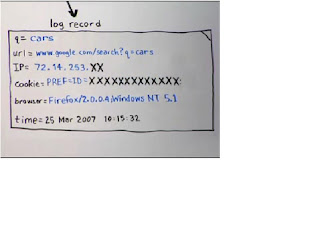
Though the interesting thing to notice is that in coming 18 months, google is going to cut out the last 3 digits from the IP log display. As well as the preference ID from the cookie like below:


This would be an interesting move to watch, this hasn’t been attempted by any search engine till now. This step on one side might annoy Web tracking companies a bit, on the other side would be a consolation for common man.

Having said all this, my simple questions to Google are:

“Did the users ask you to provide more relevant search by picking their information?”

“Did users say that I am not getting relevant search results and now I am moving to a new search engine?”

Sunday, March 02, 2008

Healthcare - IT and Google

So now Mrs. Smith will see special suggestions on how to control her diabetes and how to keep her cholesterol and blood pressure under control as per google’s ads on her personal google online Health record.

Marissa Mayer, VP, Search and user products, Google, on 28th Feb blogged about the new google product “Google Health”.

No, No, Google is going to provide you with a very secure product, maintaining integrity and what not. It’s going to give you a perfect organizer to access your online medical records from various service providers in a common place, online, anywhere in the world.

Just imagine if I can read your email (gmail), I can read your online word docs and spread sheets (google docs), I can see what images you see (picasa), I can see what pages you browse on web (web history), I can see what you like on your front page everyday (iGoogle) and I know your health profile (google health), obviously I am not going to use that information.

Quoting Marissa Mayer: “We won't sell or share your data without your explicit permission.” Obviously you won’t, why do you need to sell it? You can very well use it for 3rd party ads yourself!

I think this is a much deeper connection (tracking in marketing terms) that google will be able to leverage. Must say this is true innovation as per google’s philosophy!

Sunday, January 13, 2008

Will Telephony Calls be free in India? - Atleast for someone!

Will telephony become Free in India? Will telephony just become Internet telephony? Will 4G networks and IPV6 track the entire world with 300 Billion IP adresses? Will VOIP calls be much better than analogue calls? Will your thumb recognition become your worldwide biometric identity? Read to know more...

If we were to go by the growing clout of telecom operators in India and the fierce fight among them for Bandwidth, it's a rare chance that the telephony would become free. However, based on my previous post on how the TSPs might just turn into ISPs, this might just become true. Even the government of India through their BSNL and MTNL services is planning to launch 2MBPs free broadband internet connection by 2009.

At-least for Youth it might be...
There have been not so old instances of free service providers like Tiger etc which failed to attempt such a concept. Though, I guess it was too early for Indian markets. However, looking at how wireless telephony has expanded in India and why mobile marketing should work in India. I do see a large Youth market out there (Youth Ages 10-24, by 2025 is estimated at 349,200,000 by Population reference bureau) who would not mind listening to a 5 sec ad after every 15 minutes that they spent on phone; if there phone calls were free of charge. (Or probably the premium telephony for business users where they don’t get ads, but they pay higher rental charges.) Also they are given an option of a unique single online mobile wallet for multiple purchases in which they need to buy a monthly recharge wallet card varying anywhere between Rs 99 - Rs 1000.

So, what I am essentially saying is, having an online mobile wallet which gets recharged by a payment of Rs. X/month, like from a recharge coupon which can be bought from a local shop. (Even this will get eliminated when we will have 4G network and IPV6 so that every device will have an IP address and just a Biometric thumb recognition would be your worldwide identity.) Now, they get to talk free and have to listen to some Voice / Video Ads and probably text messages. What they just need to do is probably use the mobile wallet to buy the services being offered to them through promotions on their mobile.

Why should I buy from my Mobile Wallet?
Well anyways, wouldn’t you be buying your monthly required items like a deo or a Movie DVD (after watching the trailers on mobile) or may be a grocery or something similar? And if you get to buy the same through a Mobile phone through a special promotion being run and it gets delivered to your doorstep…obviously an hassle free shopping experience (oh did I say that Oil prices are always rising and travelling has become a challenge, specially if you have stayed in places like bangalore, mumbai, dubai etc). You can browse through the online store on your mobile and choose and pay directly through your mobile wallet safely by your biometric signature check on your mobile phone.

What’s in it for the Supplier?
Cheapest media to connect and advertise directly in the hands of the consumer. No large real estate investment, no large set-up required, no middle men’s commission, just pure B2C delivery of products.

How can you implement this?
Initially promotion of the Mobile Commerce or M-Commerce can be supported through certain specific low cost campaign launches from advertisers like contests, freebies etc. and over a period of 2 years when we see M-Commerce becoming popular, the TSPs (or WiISPs), would start charging the advertisers for the AD time which will again be contextual content ads targeted according to the buying or other behavior of the audience.

Is this model sustainable?
This is the question which we have to answer and will get answered only by looking at the response to the mobile advertising’s success in India. Would Indians accept the technology and would prefer to buy on Mobile or would still want to visit the store to buy? Would the telephone calls be completely free or the companies like Skype or Google charge the consumers to call? Would internet broadband become a reality on mobile phones or would it still be marred by the technology?

I see the light of positive hope and this approach of Mobile driven sales and marketing catching up in next 2 years time.

Saturday, January 12, 2008

Will Telecom Network Operators finally become Internet Service Providers only?

Will Telecom Network Operators finally become Internet Service Providers only? Future of Telecom service providers? Would ISP and TSPs become one? A walk back from Future...

2015. AT&T today announced their Internet Services expansion to India. “We see India is the largest Mobile Communication devices’ consumer population worldwide followed by China and our high speed, reliable mobile Internet Services would help the regular Indian consumer to enjoy most advanced telephony and Value Added Services on their ARM Mobile 1.28 GHz processor driven, Google Android / Microsoft / Symbian based, mobile communicators.” said their SVP Worldwide Marketing and Product strategy at the launch function in New Delhi.

2010. Discussing the future of Telecom business at the Worldwide Telecom Forum, the heads of Top 10 worldwide telecom network operators conclusively shared a vision, with open mobile platforms like Google Android or Yahoo Open Mobile, telecom operations have virtually came to a halt with ever decreasing revenues from Mobile Phone networks consecutively for past 2 years while VAS and mobile ads revenues are increasing. There was a consensus that the TSPs would now concentrate on their newly launched Open Mobile VAS services along with the high speed 1GBPs wireless networks. Profitability will be driven by the Ads and VAS services and the telephony will be free of charge for the consumers. This will be on a revenue sharing model with the VAS operators.

If the above claims look strange, you may want to think about what’s conspiring in the world, on the mobile scenario, again!

With Apple’s iPhone, the mobile industry has seen a completely different face of information and communication. And with Google Android’s open mobile platform, you can imagine running a mobile software, which will be capable of Voice and Data communication processing in an ARM processor, and then transmission and reception over XG (3G, 4G, 5G…) internet services. Which means, the thing in your hand, is a PC which can run something like Google Talk or Skype and you can communicate (call someone, share a song, a video or probably send a vibe(vibrator ring)), with someone who has Google Talk or Skype running on a similar mobile communication device. And with IPV6 standards this mobile phone or communication wireless device will be having an IP address too. (You can track it for contextual or behavioral marketing – Did I say Push marketing was dead?)

So what is left for the TSPs? Probably a carrier…for Internet and not for telephony. And off course 2 important things Contextual Content, Contextual Ads (in various formats like Video, Text, Audio, probably Vibration or Touch Colors etc.).

Why companies like NTT DoCoMo, Digiweb, Reliance, Vodafone, AT&T, Bharti Airtel, Tata, BT, Etisalat, Du and similar ones should now focus on a long term growth strategy of acquisition of VAS providers, content management systems and mobile application development on open devices seems obvious. Companies which can help provide Mobile Advertising solutions, Mobile Content delivery or High speed mobile internet are the real companies to look for in future. Companies which can challenge Google in creating a mobile Google checkout to purchase online and start building an online purchase history and complete behavior of browsing and purchase will become very lucrative and growth businesses.

I might be knaive and may not understand the internal dynamics, though, I do see such trends which will bring Telecom network providers to become ISPs and VAS providers and contextual content delivery in various media on a mobile communication device over Internet 4G networks would rule.

*This entry is based on my imagination and analysis and is more of an observant speculation.

Thursday, January 03, 2008

Web 2.0 Jargon for 2008, New terminology for 2008

2007 2008

Open Api’s --> More open widgets
Widgetization of the Web --> Virtual Worlds
Personalization of the Web --> Enterprise 2.0
The Web is the New Desktop --> Mobile 2.0 and Google Android
Social Networking --> Niche Social Networking
Blogging --> Corporate Blogging
MultiMedia Sharing --> Employee Community -Various media sharing
Behavioural Marketing --> Customer centric targetting

India's First Mobile Phone Ads provider - Future Predictions ALIVE

Indians are hurrying to lead the race in 2008. Grabing that extra share in mobile Marketing Pie, is showing some early signs of rapid footsteps.

An early breakthrough attempt, which needs to sustain itself for atleast couple of years before their balance sheets would post break-evens or profits. With ZestADZ (www.zestadz.com) a pioneer in mobile advertising space in India, announcing that hey will now sell ads on facebook mobile platform allowing facebook developers to integrate mobile ads with their facebook mobile apps.
ZestADZ will be the first mobile ad platform from India to offer such service for Indian mobile developers.

Using this service, facebook mobile developers can monetize their mobile applications by embedding ads from leading advertisers from India. Through this development mobile developers can now tap into the Indian mobile market which currently has more than 200 million users, many of them moving upward using mobile Internet. The facebook India network has hundreds of thousands of users from India and it is expected that just like Orkut, facebook’s popularity will soar in India especially on their mobile sites.

It is evident, both sections of people are extremely optimistic, “Mobile Social Marketing is extremely important space for us to be in and we’re getting started with facebook which is very popular in India”, said Asif Ali, CTO mobile-worx adding that “We hope that this launch enable both advertisers and publishers to capitalize of the phenomenal growth of mobile Internet in India”.

Terry Uppal, President, Mobile-worx said “Advertisers in India will now have the perfect media platform to reach a large target audience on facebook with relevant and contextual ads to generate increase their brand awareness and revenues”.

About ZestADZ
ZestADZ - India's leading mobile advertising marketplace. ZestADZ is a multi-format (WAP, SMS and mobile-video) advertising platform. ZestADZ inserts highly targeted and relevant ads and delivers compelling value to users, publishers and advertisers. ZestADZ embodies the core tenets of Seth Godin’s permission based marketing.
For more information on ZestADZ visit http://www.zestadz.com

About mobile-worx
mobile-worx is a leading provider of mobility solutions with offices in US, India and Malaysia. Mobile-worx has offices in Chennai, Mumbai (Bombay), Los Angeles and Kuala Lumpur.
For more information on mobile-worx, please visit http://www.mobile-worx.com Contact Details: Shereen Begum, mobile-worx, +91 (044) 4257 6183 Or Email

Wednesday, December 19, 2007

What’s The Future - Series | Part - 2 - PUSH/PULL Marketing is DEAD ? And 4Rs of Marketing

PUSH Marketing is DEAD(?) PULL marketing is Dead too(?)-4Rs of Marketing

According to a recent survey on advertising messages through various media, on an average working day where you travel in the morning to your office, spend a full day in office to the time you go back and sleep after watching your favorite TV channel in the evening, you are most probably going to be targeted by approx. 3000 marketing messages.

Knowingly or not, you get subjected to these messages in forms of Billboards, Radio Jingles, TV ads, Online banners, Emails, etc. These can be friendly, unfriendly, solicited, unsolicited, relevant, irrelevant messages which you would have to go through. Almost all the marketing messages come through well crafted marketing campaigns where a huge amount of time and money is spent.

However, how many of them have the “Engagement Value” perceived for the targeted audience?

According to the Economist Intelligence Unit's survey report, of sales and marketing executives worldwide, more than 80% of the executives believe that they lost the sales because they couldn’t engage their prospect enough to get them interested to buy. While it is challenging to engage prospects in the communication process, marketers are using newer techniques on their websites like, videos and rich media to engage their audience. However, the report says 47% of respondents suggested that it’s really difficult to measure how the engagement mechanism affected the purchase behavior, among the gamut of activities in the engagement process.

If it was 1950, it would have been easier to get someone to endorse the product and broadcast the message to everyone. This PUSHing the message technique worked, when people had no clue about their personal choice of “media” and their choice of “time” to access that media. However, this pushing the message across has created the biggest challenge for the marketers of this age where we have to become over cautious to choose:
- 4 Ws of marketing

what to market?
whom to market?
when to market?
which media to market through?
not only these Ws, but also how often to market.

In today’s world, consumers are essentially the sellers too. People turn to existing customers to influence their own buying behavior. So pushing the message out is completely DEAD. Is that a conclusion? PUSH marketing is really Dead? YES and NO.
YES – You can’t expect the sales through pushing the message out.
NO – You can still expect the sales through pushing the right message out.
NO contd.: - Right message defined – So, now we know, that people are buying based on other consumer’s opinions, so let’s push the other people’s opinion crafted in the manner we want, to the consumer and help them make that buying decision. The right message is the message which has the engagement value, an existing customer’s voice and a perceived need, buying urgency and a definitive benefit in it.

Is pull marketing Dead? - Yes and NO
Yes
- When everyone tries to pull the customers/prospects, then you don't know if your pull worked or not.
No - Definitely the pull marketing is the future however, customer centric behviour with the following 4 Rs approach definitely can be a great marketing strategy of Future!

A complete Paradigm Shift
4Ps --> 4 Rs
Dictating --> Listening
Researching --> Understanding through analytics
Push --> Community opinion building
Broadcasting --> Interest based Targeting

Recently I saw a presentation from Matt Langie on 4 Rs of marketing. The basic idea is as follows:

4Ps of marketing – Product, Price, Place, Promotion used to take prospects from the buying cycle moving from Awareness, Interest, Desire and Action. However, in today’s world of marketing, consumers are interested in listening to the crowds or their closed group while making a buying decision.

This has lead to the New approach of consumer centric marketing or 4 Rs of marketing - Reveal, Reward, Respect and Retain

1. Reveal – Understand your prospects and customers recent traits and past history to come up with a planned, targeted, focused, need based marketing effort.

Various tactics: -
• Monitoring unique visitors
• Online engagements
o Voting
o Surveys
o Referrals
• Referrals from other websites

2. Reward – While you gather valuable information from customers it’s essential to reward them and keep them engaged to buy more, profess more and keep them delighted.
Various Tactics: -
• Reward the customers to engage them more into your brand.
• Ask for their opinions
• Appreciate them on your online forums
• Give out some special coupons
• Give out something which they are definitely looking out for. etc.

3. Respect – A very well crafted, targeted, engaging campaign over time will build respect for your Brand. This gained respect with customers is something which will help you engage with other prospects.

While you are listening to the consumers, you are hearing what they would like just apart from your products and what values do they stand for. This is something which you can leverage to further engage with audience (customers and prospects) to further enhance the adoption.

4. Retain – Stimulate interactions with products through fun and imaginative extensions of the concept.

The basic idea is keep’em engaged.

HALT.
This brings me to a basic communication concept of networking, keeping the conversation on-going and reaping the benefits over and over again. Will talk more about it later.
CONTINUE…

A 360˚ view of the visitors or interactions:
-Listen – Survey, Onsite search, Website
-Learn – Offline Data + CRM
-Act – Email, Direct mail, Behavioral targeting

Question: How customer profiling with this 360 degree approach helps?
Answer: You can build a profile of a customer with demographics; likings etc and leverage that data for targeted marketing.

Tying it back to the Idea - Give the right information to the right audience at the right time, the way the want it and how often they want it.

To be concluded...

Wednesday, November 28, 2007

Marketing Communication Primer – What’s The Future? - Series

Marketing Communication – What’s The Future? - Series

Today I am starting this new series on my blog on Marketing communication, What’s the future?

Premise:-

With the B-Schools still teaching 4 Ps of marketing to MBA students while preparing them for businesses, the students face a stark reality when they sit for Interviews. They realize within 2 minutes of interview, that this is not what the companies are looking for.

Wow! “I worked my ass off to learn so much about marketing in my B-School and you are telling me this is not what you are looking for?” – This could be a reality check question running in mind of any B-School passout. Well the cruel answer is “YES”.

Do we blame the education for this mismatch? “No”. Then what do we do?

This series of Marketing Communication primer is going to help all fresh graduates, Marcom professionals, Strategic Marketing Professionals and Hiring Managers to see the difference in various levels of marketing, as well as, what’s the NEXT big things in Marketing to look for.

Causes for aberration:-

The prime reason why people get confused or are not well prepared for what they are looking for in their role in marketing is the lack of understanding about the two levels of Marketing.

Two Broad Levels of Marketing:
1. Strategic Marketing attempts to determine how an organization competes against its competitors in a market place. In particular, it aims at generating a competitive advantage relative to its competitors.
2. Operational Marketing executes marketing functions to attract and keep customers and to maximize the value derived for them, as well as to satisfy the customer with prompt services and meeting the customer expectations. Operational Marketing includes the determination of the marketing mix.

It’s very important for people to understand that Strategic Marketing is a function of a Sr. Marketing Professionals where the person in charge has very well mastered the Operational Marketing.

Demystifying Strategic Marketing:- In simple words it’s the Visioning Strategy linked with the execution planning. This would require the below mentioned functions:
a) Understanding Business Objectives / Goals
-Annual X % increase in revenue of a product line
-Retention and growth of Y accounts in Z geography.
-A % market share for this service / product.
-C no of competitor accounts to be captured etc.
These are some examples of wider business goals that a CEO would have in his mind.

b) Converting these business goals into plans like:- Annual / Bi-Annual / 5 Yearly, is what a senior Marketing Professional (marketing and sales director/VP/SVP) would look at and come up with a strategic plan to support the larger business objectives.
-Identifying milestones in the plan.
-Broad annual metrics to be achieved based on sales data from past or industry averages etc. these are few examples to illustrate.

c) Execution Strategy: - This is is one of the most neglected portion from a strategic perspective. Ram Charan, Author of book, Execution, stresses on this point in his book and calls execution as an essential part of strategy.
Without a clearly defined execution strategy all this is just a Bird’s Eye-view approach to say things. A very clearly defined execution strategy and plan is something which can really make these things happen. The execution strategy might look at various activities which can support the annual plans in the previous step.
-Resources required – Hiring/Training etc
-Commission and incentive buffers / Employee benefits
-Media strategy
-IT Infrastructure
-Strategic Alliances and partnerships etc.
-Tactical challenges and solutions

d) Handover of Plans:- Communicating the plans company wide to ensure effective information dissemination etc. Continuous follow-up etc.

Demystifying Operational Marketing:- In simple words, leveraging various channels / media, to generate demand and achieve organizational objectives.

4 Ps of marketing:
In popular usage, "marketing" is the promotion of products, especially advertising and branding. However, in professional usage the term has a wider meaning which recognizes that marketing is customer centered. Products are often developed to meet the desires of groups of customers or even, in some cases, for specific customers. E. Jerome McCarthy divided marketing into four general sets of activities. His typology has become so universally recognized that his four activity sets, the Four Ps, have passed into the language.
The four Ps are:
-Product: The product aspects of marketing deal with the specifications of the actual goods or services, and how it relates to the end-user's needs and wants. The scope of a product generally includes supporting elements such as warranties, guarantees, and support.
-Pricing: This refers to the process of setting a price for a product, including discounts. The price need not be monetary - it can simply be what is exchanged for the product or services, e.g. time, energy, psychology or attention.
-Promotion: This includes advertising, sales promotion, publicity, and personal selling, and refers to the various methods of promoting the product, brand, or company.
-Placement or distribution refers to how the product gets to the customer; for example, point of sale placement or retailing. This fourth P has also sometimes been called Place, referring to the channel by which a product or services is sold (e.g. online vs. retail), which geographic region or industry, to which segment (young adults, families, business people), etc.
I am not going to focus on these 4 Ps of marketing, however, I would keep them in mind as well as showcase the Future of Marketing Communication to all.

Closing Remarks:- In my coming postings: while these 4 Ps might be the basis for operational marketing I will introduce the
-5th P of Marketing.
-4 “A”s of Marketing
-Web and Internet as Business Models of Future marketing
-Newer and Exciting Channels and Media of marketing
-New strategies for Business Development
-Strategic Advances in positioning

And more…Please share your comments to help me improve my postings.

Wednesday, August 15, 2007

Targeted Marketing - Top 5 ways for Online Marketing

Targeted Marketing:- 5 most popular ways to target online:

· Contextual targeting: Ads are targeted to related content being viewed by consumers; content usually matches the advertiser's business. For example, ICICI Prudential may run its ads in the mutual fund section of a personal finance site or Hyundai Santro would run its ads in the family section of an automotive site.

o Advantages: There's an implied interest in this content and an assumption that a prospect is in market.

o Challenges: Content has a premium value and tends to be cluttered with competitive ads. In addition, advertisers rely on a small window to reach prospects.

· Demographic targeting: Ads are targeted to content that has a high composition of a specific market segment (regardless if there's a contextual fit). Demographic information may include professions, industry, company size, gender, age, and household income. For example, an advertiser who wants to reach baby boomers may advertise on a site like ThirdAge.

o Advantages: Demographic targeting provides an opportunity for advertisers to increase their reach and avoid highly competitive and cluttered contextual placements.

o Challenges: Just because someone fits a market segment, doesn't mean she's in market for a product. Demographic targeting is better suited for branding campaigns.

· Geographic targeting: Ads are targeted to specific geographical areas based on a user's IP address, Zip Code, or the local content he's viewing. An automotive dealer in New Jersey can advertise local lease offers on NJ.com or target consumers via their IP addresses on USAToday.com

o Advantages: Marketers can target consumers with relative, local-interest creative.

o Challenges: This targeting can be hard to manage since technology can be imperfect. In addition, local-interest creative isn't always available.

· Registration targeting: Ads are targeted to consumers based on the information they provided during registration. If ZDNET wants to reach independent software testers, it could exclusively target people who are regular downloaders of softwares registered as such.

o Advantages: It allows marketers to target hard-to-reach segments without wasting impressions.

o Challenges: Registration information can be outdated or inaccurate.

· Behavioral targeting: Ads are targeted to consumers based on previous activity (past content, purchase, or search history). For example, Orbitz can retarget a consumer on Yahoo who just configured a trip but didn't purchase.

o Advantages: It provides an opportunity to create a dialogue with consumers and reach them beyond contextual environments.

o Challenges: If not handled properly, it could have an adverse affect.

Saturday, August 04, 2007

Behavioral Marketing

New and emerging Idea of “Behavioral Marketing” is gripping the websites and advertisers are getting more keener on it. This basically talks about customization of Ads based on predictions on what you are going to buy next. This is like one-on-one marketing based on individual data. Like: Gender, Location, Demographics, Interests, Past website visits, Recommendations etc.
Like Book Selling Sites recommending the following:
“People who liked this also liked books like these:-
Link 1
Link 2
Link 2”
Now websites are trying to provide Real-time Ads. With the help of certain details like your Location and demographics. They are continuously collecting data about you, while you browse and on real-time change the ads from a generic one to the most relevant ones relevant to your interest.
“Auto Opt In” is the trick most of the sites are using which means you just can’t skip this.
The basic value proposition is “we are going to stop bombarding you with non-relevant ads and give you something which is very relevant to you.”
Well companies are trying to build and implement these algorithms and only some retrun on investment data will prove if this model is working well!

Some Online Citations:

nugg.ad AG - http://blog.nugg.ad/2007-07-25/is-predictive-behavioral-targeting-only-something-for-geeks-nerds-and-freaks/
Yahoo! Expands Behavioral Targeting - http://www.clickz.com/showPage.html?page=3520631
Yahoo Adds Behavioral Targeting - http://advertising.yahoo.com/marketing/bt/
Microsoft Demos Behavioral Targeting - http://publications.mediapost.com/index.cfm?fuseaction=Articles.showArticleHomePage&art_aid=38484
Behavioral Maketing - http://www.behavioral.us/2007/06/15/when-does-behavioral-fail/
Retrieved from "http://en.wikipedia.org/wiki/Behavioral_targeting"

Share this

Bookmark and Share